How Southeast Asian SMEs adopt AI, and where it pays off
Notes from Make AI Work, our workshop with UOB FinLab: how SMEs in Indonesia, Thailand and Malaysia use AI, what controlled studies show, and where to start.

Most SMEs in Indonesia and Thailand now use AI, and about half do in Malaysia. UOB's Business Outlook Study 2026, run in January 2026, found that 74% of the SMEs it surveyed in Indonesia and 71% in Thailand had adopted AI, against 53% in Malaysia [1][2][3]. Their customers are ready for it. Adults in Thailand, Indonesia and Malaysia rank among the most excited about AI of the 32 countries in the Ipsos AI Monitor 2026 [4].
On 18 August 2026, StaffOS and UOB FinLab ran Make AI Work, a workshop in Kuala Lumpur for SME owners working out where AI fits in their business. This post covers what we presented: the regional numbers, what controlled studies say about where AI pays off, and the steps we gave the room. Every figure links to its source, and where a survey has a newer edition than the one on our slides, we use the newer one.
Key takeaways
- Adults in Thailand (77%), Indonesia (76%) and Malaysia (71%) say products and services using AI excite them, against a 51% average across 32 countries.
- 74% of SMEs in Indonesia, 71% in Thailand and 53% in Malaysia have adopted AI, most of them at an early stage.
- 82% of Malaysian SMEs in a Xero survey said they need more education before they can implement AI with certainty.
- Controlled studies find AI pays off on work with a clear right answer, and helps the least experienced staff most.
- Customers expect a way to reach a person: 87% say companies using AI for customer service must provide one.
Customers in Thailand, Indonesia and Malaysia are among the most excited about AI
In the Ipsos AI Monitor 2026, 77% of adults in Thailand, 76% in Indonesia and 71% in Malaysia agreed that products and services using AI make them excited. The average across 32 countries was 51%, and the figure for the United States was 33%. Only China and India scored higher than Thailand [4]. At the workshop we showed the 2025 edition, in which Malaysia scored 77% and ranked third of 30 countries [5].
Read these numbers with one caution. Ipsos surveys online, and in these three markets its samples are more urban, educated or affluent than the population as a whole. The results describe better-connected customers, and the ranking between close scores is approximate.
The same customers expect to be told when AI is involved. 91% of Indonesians, 86% of Thais and 78% of Malaysians agreed that products and services using AI should have to disclose it [4]. For an SME, the practical reading is that customers are open to AI and want to know when they are dealing with it.
About three in four SMEs in Indonesia and Thailand use AI, and half in Malaysia
UOB's Business Outlook Study 2026 surveyed owners and senior managers of SMEs in January 2026. It splits AI adoption into early and advanced stages [1][2][3].
| Indonesia | Thailand | Malaysia | |
|---|---|---|---|
| SMEs surveyed | 272 | 265 | 268 |
| Early-stage adoption | 47% | 54% | 40% |
| Advanced adoption | 26% | 17% | 12% |
| Total adoption | 74% | 71% | 53% |
UOB rounds each figure separately, so the two stages do not always add up to the total.
Consumer excitement in the three markets sits within six points, while Malaysia's SME adoption trails its neighbours by about 20 points. In every market, early-stage adopters outnumber advanced ones, and UOB's own summary for Malaysia is that adoption remains at an early stage. Moving a business from trying AI to relying on it was the subject of the workshop.
Three details shape how to read the study. UOB is a bank that lends to these businesses, and it does not publish a margin of error. It defines SMEs by annual turnover, and the bands differ by country: Malaysia's medium band runs up to RM900 million, while the Thai and Indonesian samples leave out the smallest firms. UOB's Singapore and Vietnam samples include larger companies, so they are not part of this comparison.
Surveys of Malaysian owners point to confidence as a gap. In a survey of 1,033 Malaysian micro, small and medium businesses published by Xero in November 2025, 82% said they need more education before they can implement AI with certainty. Only 56% said they are familiar with business uses of AI, and 61% felt overwhelmed by the number of AI tools on the market [6][20]. Xero sells software to these businesses and has not published its method, so treat the survey as a signal.
Malaysians change habits quickly when a tool is convenient
DuitNow QR transactions doubled from 1.5 billion in 2024 to 3 billion in 2025. Bank Negara Malaysia credits convenience and wide merchant acceptance [7]. The channel for customer conversations is settled too: 97.7% of Malaysian internet users had a WhatsApp account in the Malaysian Communications and Multimedia Commission's 2022 survey [8].
For customer-facing AI, that makes WhatsApp the place to start. It also raises the cost of a slow reply, which our review of lead response time studies covers in detail.
What controlled studies say about where AI pays off
At the workshop we presented only studies that compare people or shops using AI with a group that did not. Four findings matter most for a small business.
The least experienced staff gain the most
A study followed 5,172 customer support agents at one software company, most of them outside the United States and mainly in the Philippines. An AI assistant raised issues resolved per hour by 15% on average, and by about 30% for the least skilled and least experienced agents. The most skilled agents gained little speed and saw small drops in quality. Agents two months into the job who had the assistant performed as well as agents with more than six months who did not [9].
A randomised experiment with 758 consultants at Boston Consulting Group found a similar pattern on tasks within the AI's abilities. Consultants in the bottom half of a baseline test scored 31% higher with AI than on their own earlier work, and those in the top half about 10% higher [10].
A small business cannot outbid large firms for experienced staff. These results suggest AI shortens the time a new hire takes to become productive.
The job you give AI matters more than the tool
Seven randomised experiments on a large cross-border e-commerce platform tested generative AI in different jobs. A pre-sale chat assistant raised sales by 16.3%. Search query refinement raised them by 2.9% and AI-written product descriptions by 2.1%. AI-written marketing messages (1.6%) and ad titles (−4.5%) showed no statistically significant effect [11].
The paper has not been peer reviewed, some of its authors worked with the platform, and the chat assistant was compared with no pre-sale service at all. Even so, the same technology produced very different results depending on the job it was given.
Outside its range, AI makes mistakes that sound right
In the consulting experiment, one task was designed to fall outside what the AI could do well. Consultants working without AI reached the correct recommendation 84.5% of the time. With AI, 70.6% did, and with AI plus a prompt-engineering overview, 60.0% did. Graders also scored wrong answers written with AI as more coherent than wrong answers written without it [10].
The risk to plan for is a fluent, well-formatted answer that is wrong, handed to someone who cannot tell.
Open-ended advice helped some owners and hurt others
In Kenya, 640 small business owners were randomly given either a GPT-4 business mentor on WhatsApp or standard business training guides. On average, the mentor made no measurable difference to profits and revenue. Weaker performers did nearly 10% worse, and owners who were already doing well may have gained over 15%, though that gain is not statistically conclusive. Both groups asked similar questions. The difference came from the advice they acted on: weaker owners leaned towards generic moves such as cutting prices or buying ads, and stronger owners made changes specific to their business [12].
Taken together, AI helps newer staff most on work with a clear right answer. On open-ended decisions, it helps the people who can judge which advice fits their business.
Customers expect a way to reach a person
In a Gartner survey of 3,566 customers in early 2026, 87% said companies using generative AI for customer service must provide access to a human agent [13]. Twilio surveyed 4,800 online shoppers in 15 countries, including Indonesia, the Philippines, Singapore and Thailand. 78% said it is important to be able to switch from an AI agent to a person. Only 15% said a handoff from an AI agent to a person had gone smoothly [14].
A clear route to a person, with the conversation so far attached, is the first thing to build into customer-facing AI.
Four boxes for sorting AI tools
With 61% of Malaysian SMEs overwhelmed by the choice of AI tools [20], we gave the room a simple way to sort them. Anything with AI in it fits into one of four boxes, and the box tells you roughly what it costs, what it can do and where it goes wrong.
| Box | Examples | Cost | Where it goes wrong | Rule of thumb |
|---|---|---|---|---|
| 1. AI you chat with | ChatGPT, Gemini, Claude, DeepSeek, Copilot | Free tiers or a monthly subscription | It helps only the person typing, and customer data should never go into free tiers | Start today, and cap spending at about RM100 a month |
| 2. AI already in your software | Features added to seller centres, ad managers, design tools, email and accounting software | Usually nothing extra | Paying for a new tool that repeats a feature you already have | Check what you already pay for before buying more |
| 3. AI that does one job | Meeting transcription, invoice reading, photo background removal, simple website bots | Cheap and easy to cancel | Subscriptions pile up unused | Add one at a time, with an end date |
| 4. AI that takes over a stretch of work | Agents that answer customers, qualify enquiries and book appointments on your channels, connected to your systems | A real investment | Running it fully automatic from day one | Manage it like a new hire |
One rule covers all four: before you pay for an AI tool, say which box it belongs in. If you cannot, you have not yet decided what you want it to do.
Five steps an SME can take this week
- Audit your AI subscriptions. List every AI tool, course and membership with the date someone last used it. Cancel whatever nobody opened this month, and add new tools one at a time with an end date.
- Share what works. Pick three tasks your team repeats every week, such as quotes, product descriptions or turning voice notes into messages. Save the prompts that work as templates everyone can use, and give them to your newest staff first.
- Write one page of AI rules. Your staff are probably using AI already. In Microsoft and LinkedIn's 2024 survey, 84% of knowledge workers in Malaysia used generative AI at work, and 83% of those users brought their own tools [15]. Yet 30% of the Malaysian SMEs in Xero's survey that had adopted AI had no policy for it [6]. List the approved tools and accounts, keep customer data out of free tiers, have a person approve anything AI writes for a customer, and name who to call when something goes wrong. Since 1 June 2025, businesses in Malaysia must report personal data breaches likely to cause significant harm to the Personal Data Protection Commissioner, within 72 hours under the Commissioner's guideline [16][17].
- Put customer-facing AI through three gates. First, test it on 20 real customer conversations, including messy ones like "boss ada stok tak the blue one saya nak 3 harga berapa". It passes when it answers by your rules and says it will check with a colleague when unsure. Second, supervise it: in the first week a person approves every reply, and angry customers, large orders and anything unusual always go to a person. Third, make sure customers can reach a person at any time, and keep a record of every message.
- Pick three numbers before you switch anything on. For customer messages, measure how long you take to reply, how many after-hours enquiries get an answer, and how many conversations become bookings or sales. Write down today's figures and check them every month. Start with reply time. In a study of 1.25 million sales leads, companies that tried to contact a lead within an hour were nearly seven times as likely to qualify it as those that tried an hour later [18].
About the workshop
Make AI Work (让 AI 实战) was a Mandarin-language session for SME owners, run by StaffOS with UOB FinLab in Kuala Lumpur on 18 August 2026.
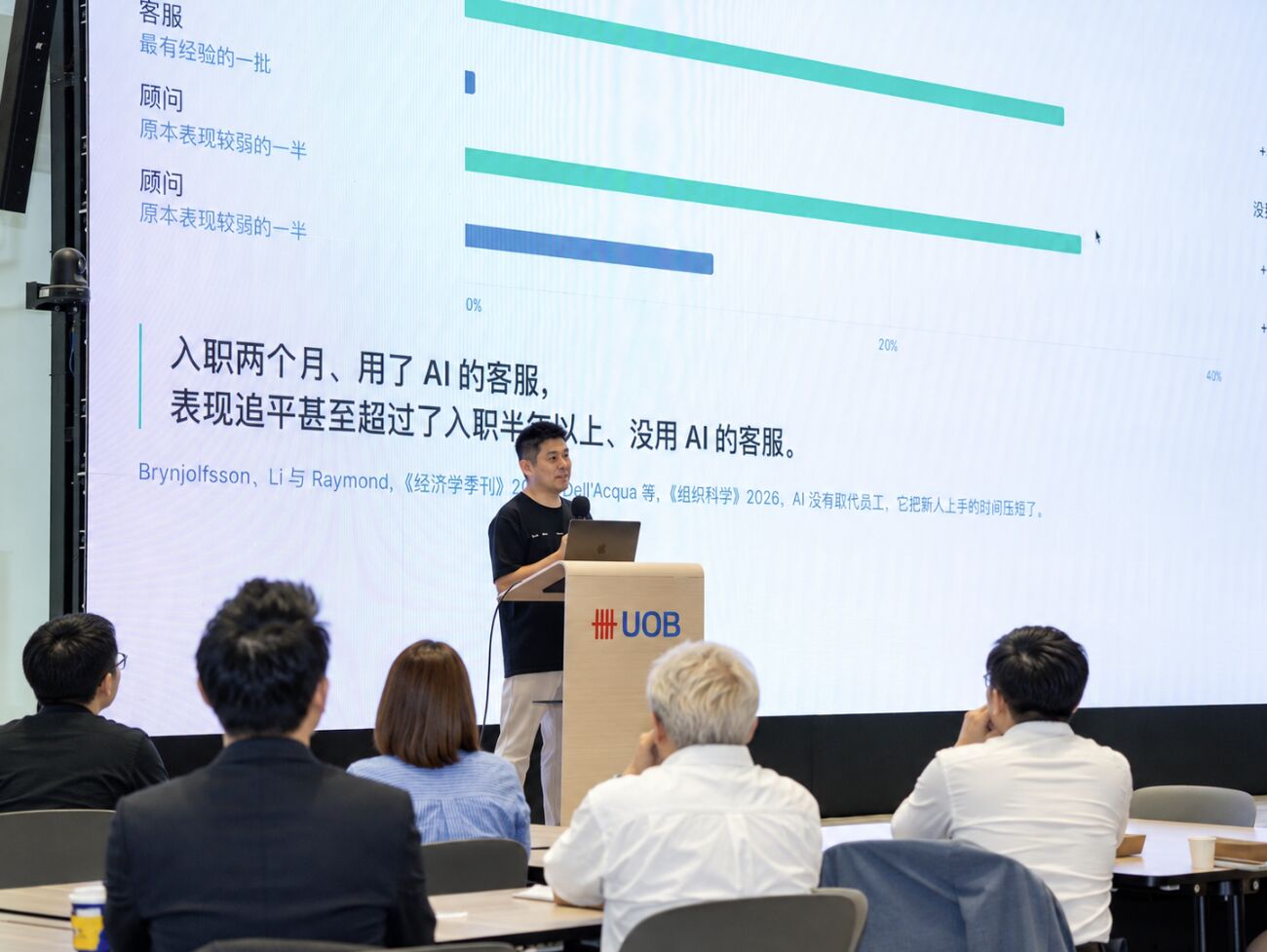
StaffOS builds agents for the fourth box. They answer customers on WhatsApp, qualify enquiries and book appointments, connected to a business's catalogue, calendar and team. We asked the room to hold us to the same three gates as any other vendor.
Related reading
Frequently asked questions
What share of SMEs in Southeast Asia use AI? +
In UOB's Business Outlook Study 2026, run in January 2026, 74% of the SMEs surveyed in Indonesia, 71% in Thailand and 53% in Malaysia had adopted AI. Most of that adoption was at an early stage. Advanced adoption was 26% in Indonesia, 17% in Thailand and 12% in Malaysia, from samples of 272, 265 and 268 SMEs.
Why do fewer Malaysian SMEs use AI than SMEs in Indonesia and Thailand? +
UOB names cost, data and system readiness, and regulation as barriers for Malaysian businesses, and says they weigh most on smaller firms. Confidence is another factor. In Xero's survey of 1,033 Malaysian micro, small and medium businesses, 82% said they need more education before they can implement AI with certainty, and 61% felt overwhelmed by the number of AI tools on the market.
Where does AI help a small business most? +
On work with a clear right answer. In a study of 5,172 customer support agents, an AI assistant raised issues resolved per hour by 15% on average and by about 30% for the least skilled and least experienced agents. In field experiments on an e-commerce platform, a pre-sale chat assistant raised sales by 16.3%, while AI-written ad titles showed no significant effect.
Should a small business let AI reply to customers? +
Yes, once it passes three checks. Test it on real customer conversations, have a person approve its replies while it starts out, and give customers a way to reach a person at any time, with a record of every message. In Gartner's 2026 survey, 87% of customers said companies using generative AI for customer service must provide access to a human agent.
Will AI replace jobs at Malaysian SMEs? +
The best local estimate measures exposure rather than job losses. A 2025 policy brief by ISIS Malaysia and the World Bank found that 4.2 million Malaysian workers, 28% of the labour force, are highly exposed to generative AI, with clerical work the most exposed. The authors define exposure as overlap with tasks AI can do, which can mean AI assisting a worker as well as automation.
What was Make AI Work? +
A Mandarin-language workshop for SME owners that StaffOS ran with UOB FinLab in Kuala Lumpur on 18 August 2026. It covered the research on where AI pays off, how customers in the region are changing, a four-box map for sorting AI tools, and five steps a business can take in a week.
References
- [1] UOB, Business Outlook Study 2026 (H1): Malaysia, infographic (June 2026)
- [2] UOB, Business Outlook Study 2026 (H1): Thailand, infographic (June 2026)
- [3] UOB, Business Outlook Study 2026 (H1): Indonesia, infographic (June 2026)
- [4] Ipsos, Ipsos AI Monitor 2026: 32-country Global Advisor survey (June 2026), pages 16 and 20
- [5] Ipsos, The Ipsos AI Monitor 2025: 30-country Global Advisor survey (June 2025), page 12
- [6] Xero, press release on its survey of 1,033 Malaysian MSMEs (November 2025), republished in full by Malaysia SME
- [7] Bank Negara Malaysia, Annual Report 2025 (March 2026), printed page 70
- [8] Malaysian Communications and Multimedia Commission, Internet Users Survey 2022, page 98
- [9] Brynjolfsson, E., Li, D., Raymond, L. Generative AI at Work. The Quarterly Journal of Economics 140(2), 2025.
- [10] Dell'Acqua, F., et al. Navigating the Jagged Technological Frontier. Organization Science 37(2), 2026.
- [11] Fang, L., Yuan, Z., Zhang, K., Donati, D., Sarvary, M. Generative AI and Sales Productivity: Field Experiments in Online Retail. arXiv:2510.12049v6, 2026. Working paper, not peer reviewed.
- [12] Otis, N. G., Clarke, R., Delecourt, S., Holtz, D., Koning, R. The Uneven Impact of Generative Artificial Intelligence on Entrepreneurial Performance: Evidence from a Field Experiment in Kenya. Management Science, 2026.
- [13] Gartner, Survey Finds 87% of Customers Say Companies Using GenAI for Customer Service Must Provide Access to a Human Agent (August 2026)
- [14] Twilio, Inside the Conversational AI Revolution (press release, November 2025)
- [15] Microsoft, 2024 Work Trend Index: the state of AI at work in Malaysia (June 2024)
- [16] Personal Data Protection Commissioner, Personal Data Protection (Amendment) Act 2024: dates of coming into operation
- [17] Personal Data Protection Commissioner, Guideline on Data Breach Notification (February 2025)
- [18] Oldroyd, J., McElheran, K., Elkington, D. The Short Life of Online Sales Leads. Harvard Business Review, March 2011.
- [19] ISIS Malaysia and World Bank, Novel AI technologies and the future of work in Malaysia (policy brief, July 2025)
- [20] e27, Malaysian SMEs grapple with a growing confidence gap in AI adoption (November 2025), reporting on Xero's survey
- [21] UOB, Business Outlook Study 2026 (H1): Malaysia, article (June 2026)
About the author
Same Tham
Co-founder / CMO, StaffOS
Same leads go-to-market at StaffOS, an AI workforce platform that runs customer support and lead qualification for small businesses across Southeast Asia.
Related reading
Agent harness engineering: improving AI without fine-tuning
How StaffOS engineers context, tools and execution controls with fixed model weights. Public research benchmarks, synthetic test cases and reproducible charts.
WhatsApp will charge for every message from October 1. The bill lands hardest on chatty automation.
From October 1, 2026, Meta bills every message a business sends on the WhatsApp API, replies in the 24-hour window included. The math, and how to build for it.
Phone number is no longer how WhatsApp identifies your customers. Most CRMs have not kept up.
WhatsApp's Business-Scoped User ID has replaced the phone number as the identity key in the Cloud API. Here is the field-by-field map of what your CRM must change.